Researcher Spotlight Survey
Tell us a little bit about yourself! What is your name, your academic title, and where are you based?
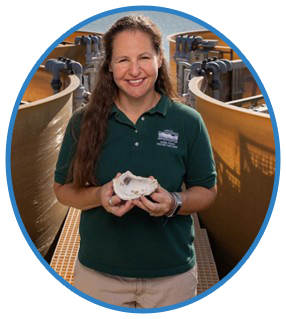
My name is Stephanie Alexander and I am the director of the University of Maryland Center for Environmental Science Horn Point Oyster Hatchery. We are located in Cambridge, Maryland, USA.
Visit the University of Maryland Center for Environmental Science to learn more and give them a follow on LinkedIn.
What field or area of research are you in or what do you study? We are in the business of oysters. We primarily produce Crassostrea virginica oyster larvae, spat-on-shell and seed oysters for use in restoration projects for the Chesapeake Bay. We also support the oyster industry through sales of larvae and seed to the commercial fishery and private aquaculture farms.
What motivated you to choose this field or study? I grew up fascinated by the natural world, and biology/environmental science was my chosen college major, but an undergraduate experience with the Horn Point Oyster Hatchery was what really set my path in motion. I had no previous background with oysters, but participated in a summer internship at the HPL Hatchery and fell in love with the physical nature of restoration, and oysters themselves. After I graduated, I was offered a full-time position at the hatchery, where I remain to this day. I can honestly say that I love my job and it gives me a great sense of accomplishment to be giving back to the Chesapeake Bay community.
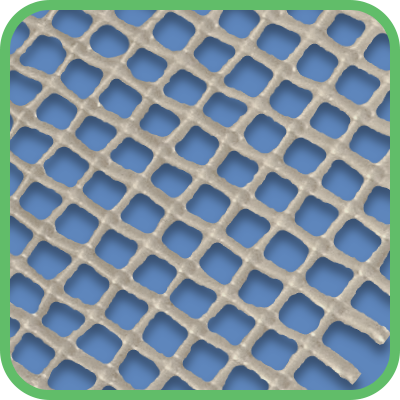
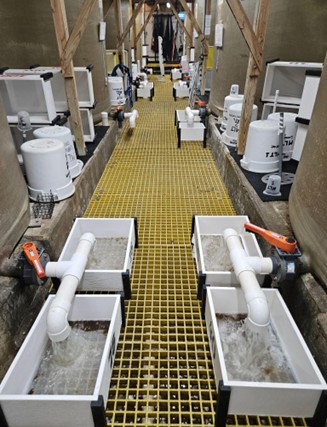
How do you use Component Supply products in your research or work? We use nylon (also known as polyamide), a fine mesh sold by Component Supply, to help us perform water changes to grow the oyster larvae. The nylon screen is placed on large frames, which we call sieves. These sieves are placed under a larval tank, and the tank water is drained through the box. Larvae are retained on the nylon fabric, while the dirty water drains through the screen. (Think spaghetti colander). Larvae are then transferred to buckets and counted, the tank is cleaned and refilled, and the oyster larvae go back into the tank to continue to mature. This process is completed every few days to maintain proper water quality conditions to ensure healthy oyster growth and production. In 2024, we drained over 730 tanks during our hatchery season, producing over 3.9 billion pediveliger oyster larvae.

How do you see your research evolving over the next years? I hope to see oyster restoration progress in the Chesapeake Bay region. Oysters are great at filtering the water and cleaning it up by removing particulates from the water column, creating hard bottom habitat, reproducing and adding to future generations, reducing wave energy protecting our shorelines, reducing excess nutrients, and providing a food source as well as a way of life and an economy for the State of Maryland. We will also persevere to produce oysters for sustainable aquaculture practices.
Tell us something fun or interesting about yourself! Whether it’s a hobby, an unusual talent, your favorite place, or just something that makes you, you! I have a random talent of being able to take great “selfies” with a large group of people. My co-workers have renamed “selfies” to “Stelphies” in honor of this skill. I love to be in the woods, or on the beach and am obsessed with taking sunrise pictures when I walk my dogs in the morning.
A big thanks to Stephanie Alexander for participating and letting us share her passion!
CS REAP is the Research Engagement and Awareness Program of Component Supply. We want to see researchers, students, and product designers worldwide REAP the benefits of advancement in R&D that help them overcome obstacles. To participate, customers can fill out a Component Supply survey highlighting their work. We will use this information to feature them on our blog. Once the blog is published, the featured customer will receive a promo code for a discount on their next order and a link to the blog post to share. We will highlight your survey on our blog, social sites, and newsletter. Together, we can Change The World!