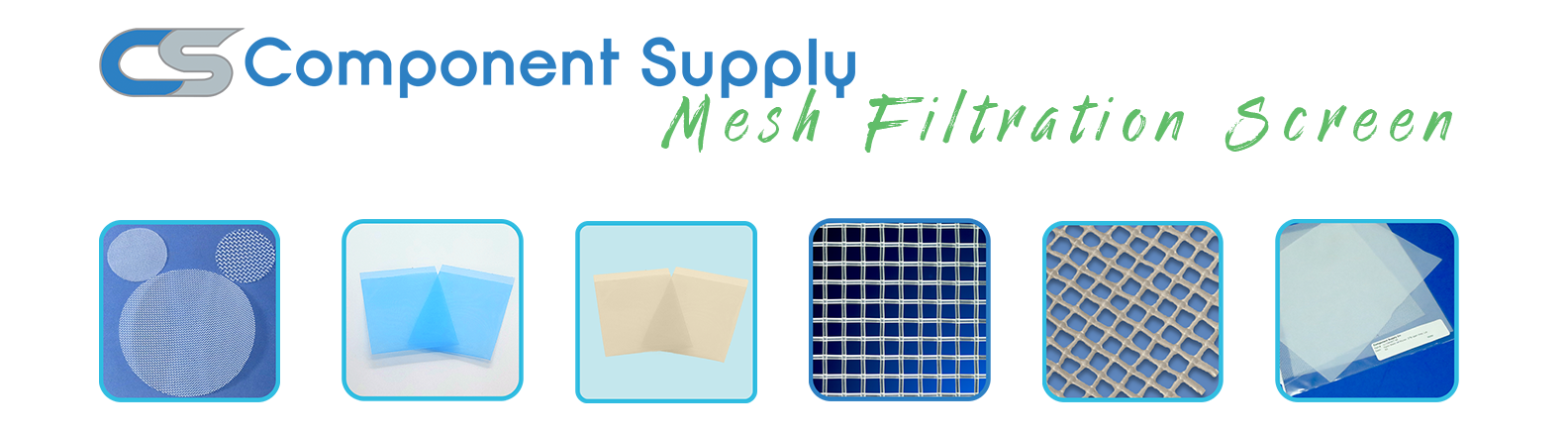
How to Determine Nylon and Polyester Mesh Sizes for Your Application
At Component Supply, we often hear from engineers and researchers looking to replace nylon or polyester mesh in their equipment or filtration systems. One of the biggest challenges is that many users don’t know the size of their existing mesh—or even the material type. While identifying whether it’s nylon or polyester depends on the application, determining the mesh opening size is usually the primary concern.
Our mesh products are monofilament woven mesh with a plain weave, which is the standard construction used in most applications. When people ask for the mesh size, they are typically referring to the mesh opening, which dictates what will pass through and what will be filtered out.
Measuring the opening directly can be difficult. For example, 100 microns equals just 0.004″, making accurate measurement with standard tools challenging.
A practical way to estimate mesh size is by using the mesh count, which is the number of threads or openings per inch. While this method is not exact, it helps narrow your options. For example, if you count 50 threads in 1/2 inch, doubling that gives a mesh count of 100.
When you reference a mesh size chart, you may not find an exact match—and that’s okay. This process usually narrows your choices to fewer than six sizes, which is often sufficient.
Tip: A standard sheet of copy paper is about 100 microns thick, so a variation of 10–20 microns typically does not affect most applications.
If your application requires a precise match to existing mesh, or the size is critical, please contact Component Supply. Our team can help you identify the correct nylon or polyester mesh size and ensure it meets your exact filtration or screening requirements.